Sunday, July 10, 2016

A Fun Old-School Discussion with Moe Tousignant

Starting on July 7, I had an interesting discussion about the structure of a couple of retro-clones with Moe Tousignant, who is something of a games expert, running lots and lots of game nights in Canada, and thus extremely familiar with the general structure of games, how they work, and what makes some fun while others are less well-designed for fun.

Moe had started reading the Swords & Wizardry pdf, and had the following comment on facebook as he was reading:

"I'm finding it hard to see what makes this any different from the other games of its type. Every OSR game reads very similar," and then, later: "Found some bits I did like, multi-classing and dual classing seemed to be handled well. Alignment seems to be based on Mike Michael Moorcock vs. Tolkien (or wherever D&D got their alignment system). I dig the few extra abilities Fighters get. At least I'm finally starting to see some differences."

I happened to be in that sort of mood, so I jumped on the thread with some thoughts. Granted, I created something of a wall of text, but I came up with the following: 

Hi Moe, you're absolutely right that the system itself is extraordinarily similar to other OSR games, just because as a retro-clone it tries to reproduce a system that was very similar to the other D&D versions that came out prior to 3d edition. All the retro-clones are highly similar, and then you see the sudden massive shift in the 3E-based Pathfinder retro-clone-method. S&W is to some degree an outlier because OD&D (the S&W source system) had more areas that were basically gaps left for the table to rule, which is why the S&W book has lots of areas where "there's no rule here, but here are some of the historical ways that people ruled it." Initiative is the biggest one of these gaps -- there wasn't an initiative system in OD&D until one of the later supplements. What I tried to do with the book was to (a) codify and combine supplements, (b) present the system in a way that's more readable for people who learned to read an RPG book using the organizational presentation used in AD&D and beyond, (c) provide a pathway for people to begin an introductory game from what is at a more advanced level a welter of potentially-confusing options and gaps, and (d) offer those alternative versions of tested house-rules for when people essentially understand the game and want to try out the various other options. So if you're looking for what's unique in S&W as opposed to other OSR systems, it's actually the *gaps* that are the unique features, not so much the places where there's a firm rule. That's where OD&D really differed from the post-OD&D systems.

Most other retro-clones also have interesting design-backgrounds and author intents. Labyrinth Lord, which is a clone of Moldvay Basic D&D, tries to reproduce an approach that was (at the time) quite the opposite of OD&D -- namely, an emphasis on a more elegant rule-system that was internally very complete. Still open-ended and designed on a concept of a high level of DM fiat, but without the need to house-rule any fundamental portions of the rules (such as initiative). The rules of Moldvay basic, as reproduced by Labyrinth Lord, have a much more defined outer boundary than OD&D, and it was that outer reach where the house-ruling and the high-creativity are supposed to kick in, based on a firm foundation of a well-defined, elegant, clear system. In OD&D, the house-ruling and high creativity are required at the very fundamental level of the essential rules, which is nowadays probably considered bad game design. My "default introductory path" through the rules, in S&W, was intended to help people jump the gap over the vagueness of the basic rules, and then return to that creative-point once the basic functioning of the game is well established and people can be comfortable with the idea of options that strike right to the core of the game's basic rules.

It's these relatively subtle nuances that distinguish the clones from each other. As playable systems, resources for one retro-clone are almost entirely usable with another clone rule-set. As approaches to the "feel" of a game, though, they are quite distinct and nuanced. For those who aren't stalwart aficionados of the old games, a discussion of retro-clones sounds as bizarre as a wine-tasting discussion (or beer, as the case might be :) ). And frankly, those distinctions aren't really important at that level of subtlety to almost anyone. The "old school" experience generally has to do with the open-endedness of the rules, and all of them have that common quality.  

Wednesday, July 6, 2016

Kickstarter News: City of Bard's Gate Headed for Stretch Goals

https://www.kickstarter.com/projects/froggodgames/the-lost-lands-bards-gate-for-5e-pathfinder-and-sa
If you like fantasy cities, you're probably already watching this Kickstarter, but the news of the day is that it has funded at the $70,000 level and is now headed into stretch goal territory with 60 hours left to go. It's hard to say how many of the goals it will hit, but Frog God Kickstarters tend to have a massive surge within the final 48 hours or so. At least another $10,000 will flow into this project before it finishes.

The cloth map is incredible, and the book is going to be massive in the tradition of Frog God releasing one or two giant, epic books per year. This will indeed be an epic book, in full color, and while it's perfectly usable as a stand-alone city in any campaign, it's also tied in to over a decade's worth of Necromancer Games and Frog God Games adventures. Basically, it's the "City State" of the Lost Lands world setting.

Very much worth taking a look.

Monday, July 4, 2016

The Spawning of Haskins!

Chris Haskins of Frog God Games, Nord Games, and Tabletop Library is officially a dad! The baby is a healthy boy, and all of us are waiting impatiently for him to eventually join a gaming table in the footsteps of his illustrious and very tall father.

So here's to wishing Chris a good night's sleep at some point in the next couple of years, if he's lucky.

I am putting Chris's affiliate number into this link, so if you want to buy anything from Tabletop Library today (or at any point), go through this link (not the one on the side over there), and Chris will get an extra share of the amount of your purchases. ALSO: if it's the 4th or 5th of July when you read this, remember to put in the code HAPPY-4TH so you get the 25% discount for 4th of July.

I'd say it might give Mr. Haskins an extra bit of beer money, but it's all baby-formula money for a little while, Chris!

Congratulations!

Saturday, July 2, 2016

Flashback to the Present (a new review of S&W)

https://tabletoplibrary.com/products/swords-wizardry-complete-rules-0e/
It has been a while since there was a review of Swords & Wizardry, since the game's several years old now, but Endzeitgeist has just posted a review on the Tabletop Library site. This is actually rather important, in my view, because Endzeitgeist is known as possibly the pre-eminent reviewer of Pathfinder books, not old-school rule sets. So this represents another step into the mainstream gaming audience for old school rules. Obviously, that march has been going on for quite some time, but this represents a new piece of the mainstream terrain.

I've linked to the page (you might have to hit the "reviews" tab to see the review. The pdf is free, and if you haven't taken a look at these rules, I encourage you to follow Endzeitgeist's advice and do so. As he points out, this is Original D&D (as close as you can get, anyway) in a codified and re-organized format.

While you're on Tabletop Library, browse around and take a look at some of the other products, too. Publishers get paid a higher percentage here than they do at the big competitor.

Friday, July 1, 2016

Bard's Gate Kickstarter: Final Week

https://www.kickstarter.com/projects/froggodgames/the-lost-lands-bards-gate-for-5e-pathfinder-and-sa
Bard's Gate is a city of burgeoning political and mercantile power, filled with intrigue and danger. Almost every large book by Necromancer Games and Frog God Games has some sort of tie to Bard's Gate, since it's historically the "big city" of the Lost Lands campaign. The Kickstarter is for a full-color, greatly-expanded city book, and is available for Fifth Edition, Pathfinder, and (best of all) Swords & Wizardry!

If you're doodling around with a Lost Lands campaign, or if you want to import a city into your own home campaign, this book is a must-have. The Kickstarter is in its final week, so take a look now!

Thursday, June 30, 2016

Two New 5e Resouces - One free, one inexpensive

https://tabletoplibrary.com/products/deep-magic-clockwork-for-5th-edition/
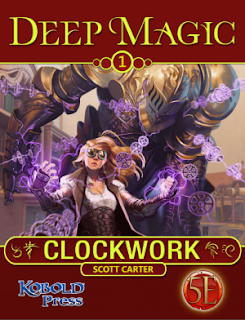
We had a couple of new Fifth Edition products at Tabletop Library today. One is free, and one is the first in a series. The Deep Magic series is by Kobold Press, and is a serialized conversion of their Pathfinder Deep Magic book. This first part of the series, Clockwork, contains some stuff that's definitely new in terms of Fifth Edition:
  • A Clockwork domain for clerics, featuring Improved mending, Channel Magic, and Clockwork Apotheosis
  • The Great Machine pact for warlocks, with three new invocations: cloud of cogs, heat of the furnace, and voice of the machine
  • A Clockwork Mage school of wizard magic, with new abilities including Clockwork Savant, Clockworker’s Charm, Metal Shape, Golem Form, and Clockwork Mastery
  • 45 new and updated spells, including chains of the goddess, gear barrage, hellforging, robe of shards, and more!
Clockwork is currently only $2.99 for the substantial pdf, which makes it a smoking good deal if you're building unusual ideas into a 5e campaign.

https://tabletoplibrary.com/vendor/rusted-iron-games/
Our other new Product is a free one-page generator for books found in a library, published by Rusted Iron Games along with several other free one-page resources.


Wednesday, June 29, 2016

Old School "Syndrome"

Note: this article only really talks about old school D&D, not about other game systems, even if they date back to pre-1980. Certain parts of it can probably be applied to other games, but I don't think that the analysis necessarily translates.

One of the factors involved in the Old School Renaissance (which is now pretty naissanced, to coin a phrase) has always been quite a bit of argumentation about who's "in it" and who's "out of it." At the very beginning, Rob Kuntz emphatically rejected the idea that he was in an OSR, since he'd been playing old school all along. Many people got very dogmatic about a certain set of "tests," and different "tests" were a popular topic for quite a while. Rob saw the proliferation of "tests" as being the manifesto of a "movement," and since he considered himself not to be part of a movement with exclusions, he opposed the entire idea.

That may have been a correct read on that particular phase of the OSR, actually. It hit a dogmatic patch early in its self-definition, which is also the reason, I think, that RPGPundit also rebelled against the idea that the OSR had any particular value. This despite the fact that his own opinions dovetailed fairly closely with what most of the OSR people were saying.

Anyway, I'm not going to even try, in this article, to propose any kind of overarching definition of the OSR, especially since it still has a variety of different expressions. However, I'd like to mention a very incisive comment by a poster named Wheggi. His comment was that old-school gaming isn't defined by any particular set of attributes: it's more like a syndrome, where if enough factors from a larger set are present in a game, it can be called old-school for lack, frankly, of a better term.

I'll propose a few of these factors, but what's interesting is that some are purely historical, and others evince a system approach that stands outside of its historical context. I tend to think in terms of that ahistorical system approach as being old school, although I also have personal preferences in favor of lots of the other factors -- I just wouldn't consider those other factors to define borders on the definition. I also think that some or many of the historical-context factors can serve to make a game more old school than another, without necessarily making it better or worse.

My own, overarching view of what old-school means is that the rules are open-ended, meaning that the players aren't constrained to particular actions on a character sheet, and that there is a great deal of interpretation, or refereeing, required on the part of the DM. This generally means that "rules-light" is a factor, but not necessarily. You can have an extensive set of rules that don't constrain the DM, they simply define player options. D&D 5e is thus in my mind considerably more old school than D&D 4e, and even 3e. As a rule-set, anyway.

However, here are a few other factors, and REMEMBER I'm not saying ANY of them are independently a defining feature of old-school gaming. Most people will react to several elements with "that's not old school at all," which is my point. The thing is that all those people who reject particular elements ... will pick a DIFFERENT combinations of elements to criticize. Which makes all of them relevant, and none of them dispositive. Also, just because I say something is ahistorical doesn't mean that it's not also part of the historical context, it just means that it can be seen as an old-school principle that isn't purely lodged in time.
  • The open-ended, few-rules-on-DM approach I just mentioned (purely outside historical context, it's a game-design and play-method principle)
  • Actual rules from the old days, not a retroclone or a later-produced edition (part non-historical, mostly historical context)
  • Black & white art, the printing methods used in the early time period (this I consider only to be partly historical, since it's actually something else as well, not just the way books looked in the early days of D&D, but also the way they looked during the Medieval period being presented).
  • Blue maps on graph paper (okay, that's purely based on historical context)
  • Maps are very much diagrams, with few artistic elements (partly historical-context, but also a non-historical preference for having maps that are easily read during play)
  •  Gygaxian prose. (Mainly historical, but as a writing style it does have some independent, non-historical effect in terms of flavorful reading)
  • Using retro-clones in preference to newer games, even if you don't use actual original rulebooks. (In many cases this is due to the fact that retro-clones have a large audience, available and often-free pdfs, and new products coming out, so it's more of a community and convenience issue than a game-method -- I guess that's non-historical).
  • Killer DMing style. This sucks, and is one of the potential failures of an open-ended gaming style, not a defining attribute.
  • Letting the dice fall where they may. This is different from aggressive killer-DMing, and I think it fits in as a characteristic of old-school gaming as long as you realize that many, many old-school DMs don't necessarily stick to this approach all the time. Frank Mentzer is, I think, one of the group that focuses on player skill as an offset to the game's purely random element. On the other hand, I think the "dice fall where they may" is an outgrowth of the wargaming roots of the game. It's also a definable, non-historical style of play. So I'll include it as a non-historical element of old school gaming, and a good example of how not every element here is required to push a game into the "old-school" category. 
  • Weapons and armor remain within historical boundaries, not reaching anime proportions. (I think that's actually a non-historical element, although it's mostly aesthetic)
  • Rocks fall, everyone dies. (Non-historical, this is simply a gaming method that takes common sense into account rather than using dice in silly situations. However, filling your adventure with this sort of lethal-but-common-sense trap approach can still fall into the killer-DM category, which is poor adventure design)
  • Zero to Hero. This is non-historical, having to do with the strength of starting characters relative to regular people. Many people in the oldest days would still start the characters at higher level than first. It provides, though, a human scale to the heroes, making the game grittier even when the game is at higher level, so it's a definite contrast to newer approaches in which the characters have a sort of super-human feel.
  • Sandbox, not railroad. This is both historical and non-historical. It's clearly a matter of design and play-style, which is independent of historical context. However, it's very much connected to the fact that during the 2e period a series of highly railroady adventures were published by TSR, and that most post-2e published adventures are also far more railroaded than what was common in the pre-2e era. This is one of the areas where 1e and 2e people tend to squabble about what's "old school."
  • Whatever edition you started with is old school. Very common psychology, obviously not actually relevant in any objective sense.
  • No diplomacy checks or other die rolls that can substitute for role-playing that sort of encounter. This is ahistorical, and I think it's a fairly major element.
  • Level tends to be more important than character attributes. This is ahistorical in the sense that it is clearly an attribute of the game's design rather than the way in which it's played. It's also probably the one feature of old-school that absolutely doesn't map onto other games than D&D, and doesn't even map onto other games existing in the late 70s.